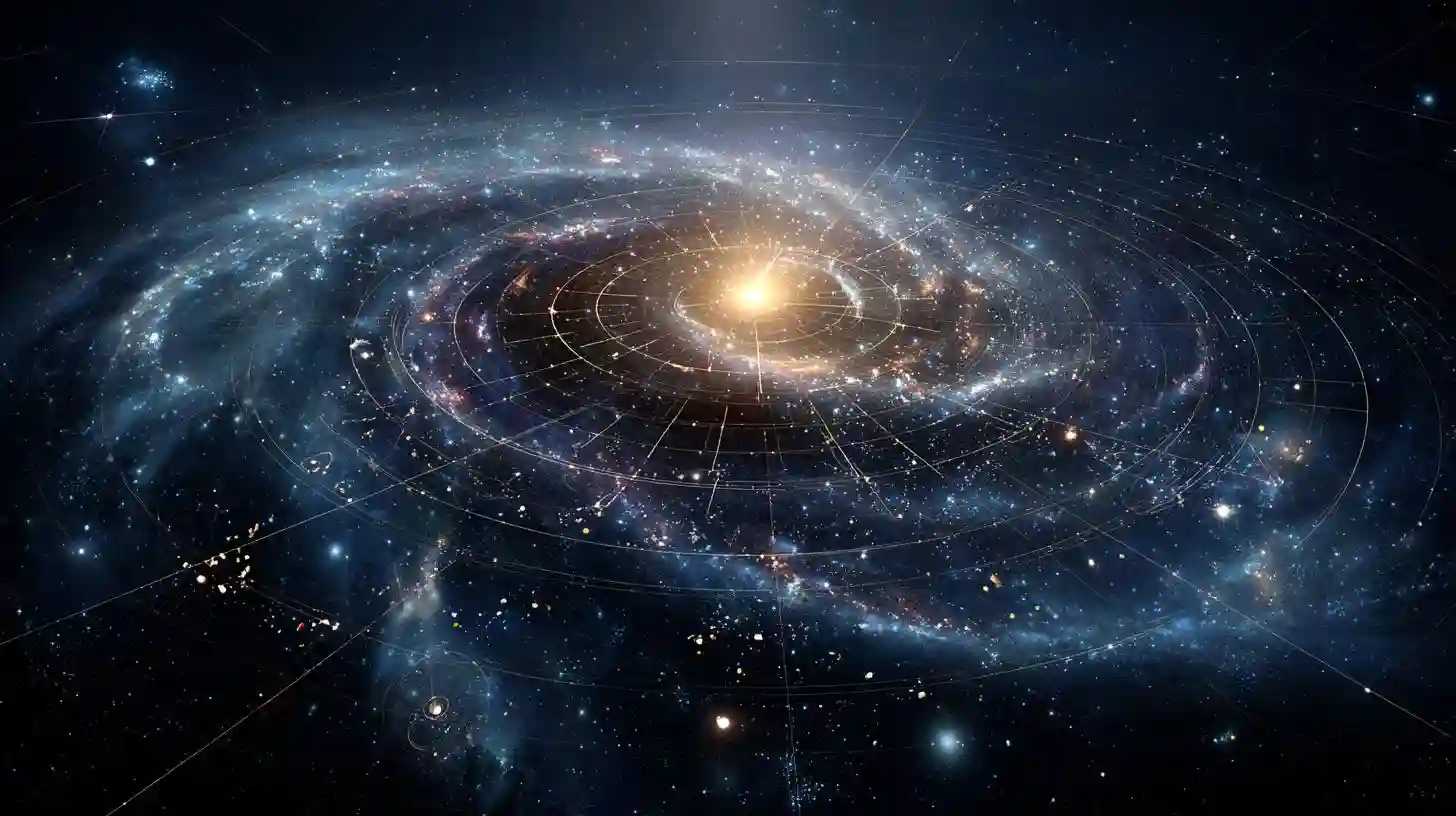
Gravity plays a fundamental role in the formation of galaxies and solar systems, shaping the very structure of the universe. It is the invisible force that governs the motion of matter, drawing particles together and initiating the processes that lead to the creation of stars, planets, and entire galaxies. In the early universe, gravity acted as the cohesive force that pulled matter, mostly hydrogen and helium gas, into dense clouds. These clouds, under the influence of gravity, began to collapse and contract, eventually reaching a point where nuclear fusion could occur. This marked the birth of the first stars. As these stars formed, their gravity began to influence the surrounding material, further shaping the environment. In the case of galaxies, gravity played a crucial role in holding together vast collections of stars, gas, and dark matter, forming the distinct spiral or elliptical shapes seen today. The interaction between stars, gas clouds, and dark matter within galaxies results in complex structures like spiral arms or galactic bulges, all held together by gravity. Similarly, gravity is the primary force behind the formation of solar systems. Once a star forms, the remaining gas and dust surrounding it begin to clump together due to gravitational attraction. These clumps, or protoplanets, collide and merge over time, forming planets, moons, and other celestial bodies. The force of gravity dictates the orbits of planets and moons, keeping them in stable paths around their parent stars. The balance between a star’s gravitational pull and the centrifugal force of orbiting bodies ensures that planets do not spiral into their stars or drift away into space. This delicate balance allows for the stable conditions needed for life to evolve on planets like Earth. Thus, gravity is the invisible architect behind the formation and structure of galaxies and solar systems, constantly shaping and guiding the universe’s evolution over billions of years.